
tu_nlp_char_rnn — Character-level RNN text generation
Source-owned OA v0.12.0 SDK tutorial. Recorded results qualify the named device and driver.
Train a small recurrent language model on OA's GPU engine and generate
text. The model reads a 576-character teaching corpus, learns to predict
the next character at every position, and after 300 optimizer steps
generates a fixed 80-character continuation from a short prompt — the same genre
as the classic TensorFlow text generation tutorial, driven end-to-end
through oa::ml autograd.
What this tutorial covers
- Character tokenization and a deterministic dense sampler
Embedding→RNN→Linearmodel composition- Training with
ItTraining,GradientTape, andAdamW - Whole-program capture: one recorded step replayed 299 times
- Checkpoint save/reload with exact optimizer and generation state
- Rendering the training curve through
oa::plot
The data
The corpus repeats this 192-character Hamlet excerpt three times, for 576 characters total (including spaces). The displayed line breaks are spaces in the input:
1to be or not to be that is the question whether tis nobler in the mind2to suffer the slings and arrows of outrageous fortune or to take arms3against a sea of troubles and by opposing end them4
The character vocabulary is a-z plus space — 27 tokens. Each training
sample is a window of 16 consecutive characters; the target is the same
window shifted one position left, so the model makes a prediction at
every position rather than only at the end. CharSampler draws
batch=64 windows per step at deterministic offsets, which is why every
run uses the same training windows. Exact reference output is checked
on the qualified device; this is not a cross-device bitwise guarantee.
The model
| Stage | Shape | Role |
|---|---|---|
Embedding | 27 → 32 | per-character dense features |
RNN (Elman) | 32 → 64 hidden | sequential context |
Linear | 64 → 27 | next-character logits |
8,891 parameters total. nlp::CharRnn::new(&engine) owns the parameters
as device Matrix values; model.forward(&input) returns logits for all
16 positions of all 64 sequences in the batch.
The training loop
Each step is a prepare/record pair handed to ItTraining, which owns
batching, metrics, GPU timing, and the captured-step lifecycle:
1assert!(training.step(2 || {3 let (input_values, target_values) = sampler.next_values()?;4 Ok((5 oa::Matrix::new_from_slice(&engine, [batch, nlp::CONTEXT_LENGTH], &input_values)?,6 oa::Matrix::new_from_slice(&engine, [batch * nlp::CONTEXT_LENGTH], &target_values)?,7 ))8 },9 |(input, target)| {10 let tape = oa::ml::GradientTape::new();11 let logits = model.forward(&input)?;12 let loss = oa::ml::loss::cross_entropy(&logits, &target)?;13 tape.backward(&loss)?;14 Ok(loss)15 },16)?);17
The GradientTape records the forward graph; backward walks it and
AdamW consumes the gradients. Because the step shape never changes,
ItTraining records the program once and replays it — the run summary
reports 19 nodes · 1 recording · 299 cache hits, i.e. the whole
training loop is one captured GPU program replayed 299 times.
Results
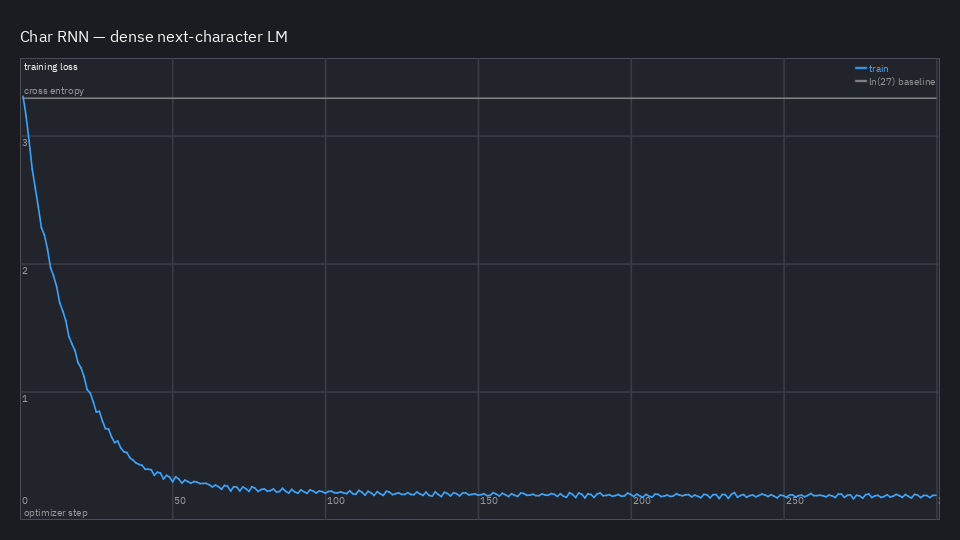
Measured on a real 300-step run (Intel Iris Xe, ADL GT2, release build):
| Metric | Value |
|---|---|
| Initial loss | 3.311 (random baseline ln(27) = 3.296) |
| Final loss | 0.186 |
| Character accuracy | 92.5% |
| Wall time | ~1.7 s · 5.6 ms/step · ~183K token/s |
| Program | 19 nodes · 1 recording · 299 cache hits |
Greedy generation from the fixed prompt is:
1prompt: "to be"2generated: "to be that is the question whether tis nobler in the mind3 to suffer the slings and ar"4
The model has essentially memorized the periodic corpus — the point of the tutorial is the pipeline, not generalization.
Checkpointing
The tutorial finishes by exercising the .oam native checkpoint codec:
oa::ml::save_checkpoint serializes parameters and optimizer state, a
fresh model reloads them, and the code asserts identical optimizer step
count, identical accuracy, and byte-identical greedy output.
Run
cargo run --release -p sdk --example tu_nlp_char_rnncargo run --release -p sdk --example tu_nlp_char_rnn -- --steps 300 --batch 64 --lr 0.01
Regenerate the training curve into asset/:
cargo run --release -p sdk --example tu_nlp_char_rnn -- \--plot sdk/rs/tutorials/ml/nlp/tu_nlp_char_rnn/asset/training-curve.png
On the default recipe the tutorial is also a self-test: it asserts the loss regime, ≥90% accuracy, and the exact reference generation.
Where to go next
The same workload runs across the 5×3 model/tokenizer matrix — swap the model for , , or , or switch the tokenizer to packed bytes () or learned BPE () for the byte/token comparison.
Python peer: — same recipe, loss/accuracy tolerance gates, and exact generation reference.
Terminal output
Recorded canonical 300-step run on Intel Iris Xe (ADL GT2), Mesa 26.2.7. Startup logs, intermediate progress updates and the plot-save path are omitted. Timings vary by run; these are not new benchmark baselines.
╔══════════════════════════════════════════════════════════════════╗║ OA Tutorial — Char RNN · all-position LM (autograd) ║╚══════════════════════════════════════════════════════════════════╝tokenizer: character · vocab=27 (a-z + space)Task: dense next-character prediction at every positionModel: Embedding(32) → RNN(64) → Linear(27)params: 8891 Optimizer: AdamW(lr=0.01)training: 300 steps · batch=64 · sequence=16 character tokens300/300 |██████████| 1.53s · 5.11 ms/step · 12.51K sample/s · 200.21K token/s · loss: 0.1858Summary:loss: initial 3.310753 · final 0.185840 · mean 0.359316Wall: 5.11 ms/step · 12.51K sample/s · 200.20K token/sGPU (char_rnn_training_step): mean 4.309 ms/step · p50 3.267 · p95 11.018 · min 3.006 · max 14.298 · 14.85K sample/s · 237.63K token/s · wall-GPU gap 16%run: 1.53s · 300 steps · batch 64 · sequence 16 token/sampleEvaluation:Random-loss baseline ln(27) = 3.2958character-token accuracy: 92.5% (compare within Char only)Generation:prompt: "to be"generated: "to be that is the question whether tis nobler in the mind to suffer the slings and ar"program: 19 nodes · 1 recording · 299 cache hits · 0 uploads