
Mobile Lab
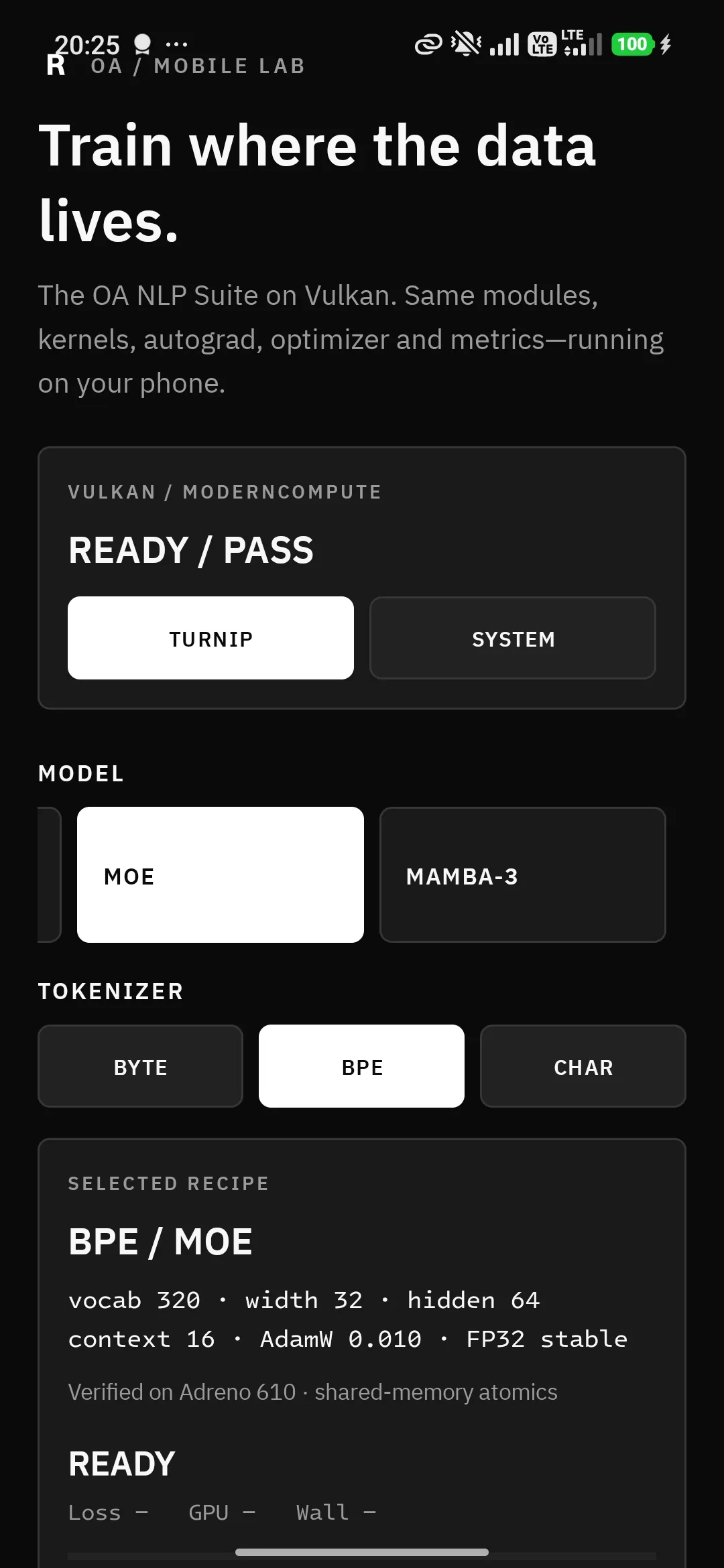
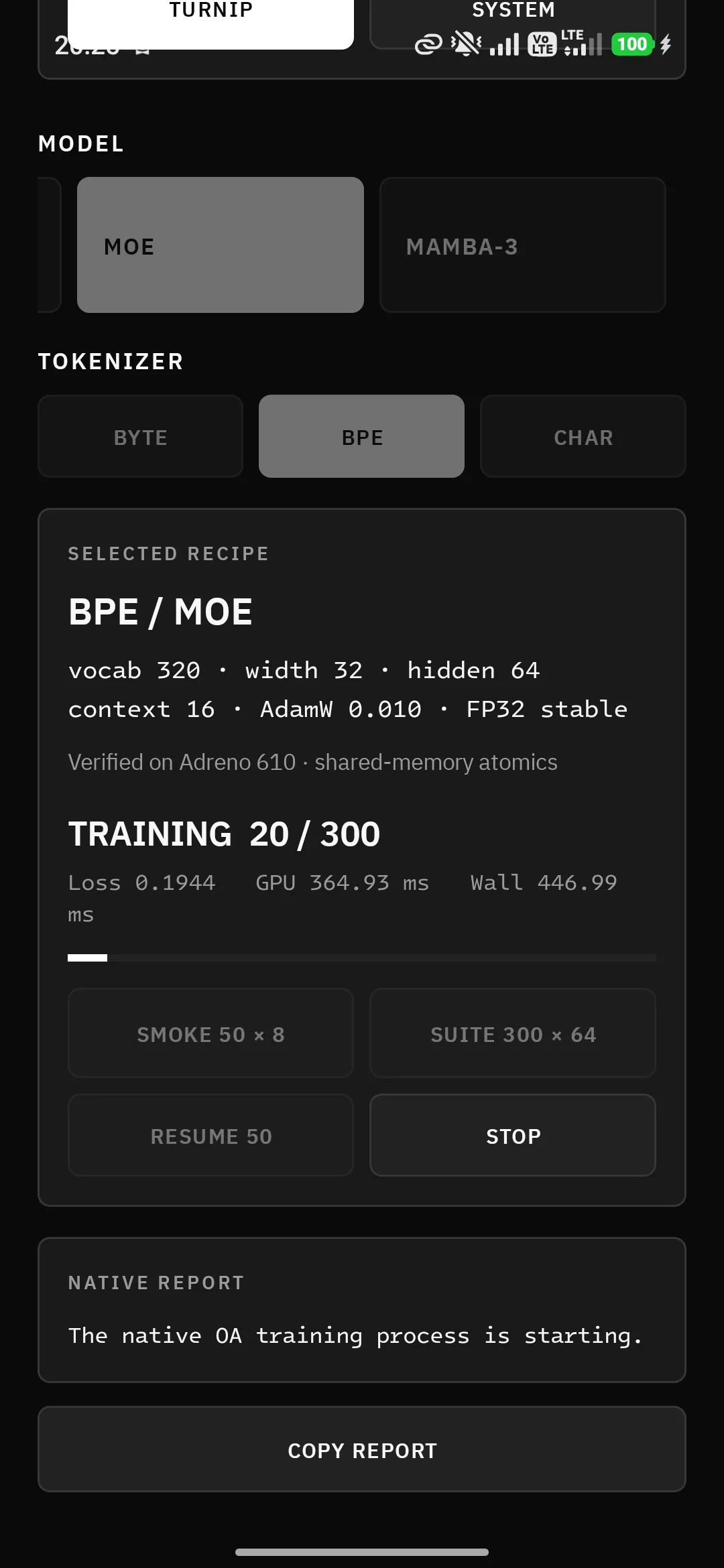
A physical-device reference application that trains, evaluates, generates, saves, and reloads OA neural networks through Vulkan on Android.

Why it exists
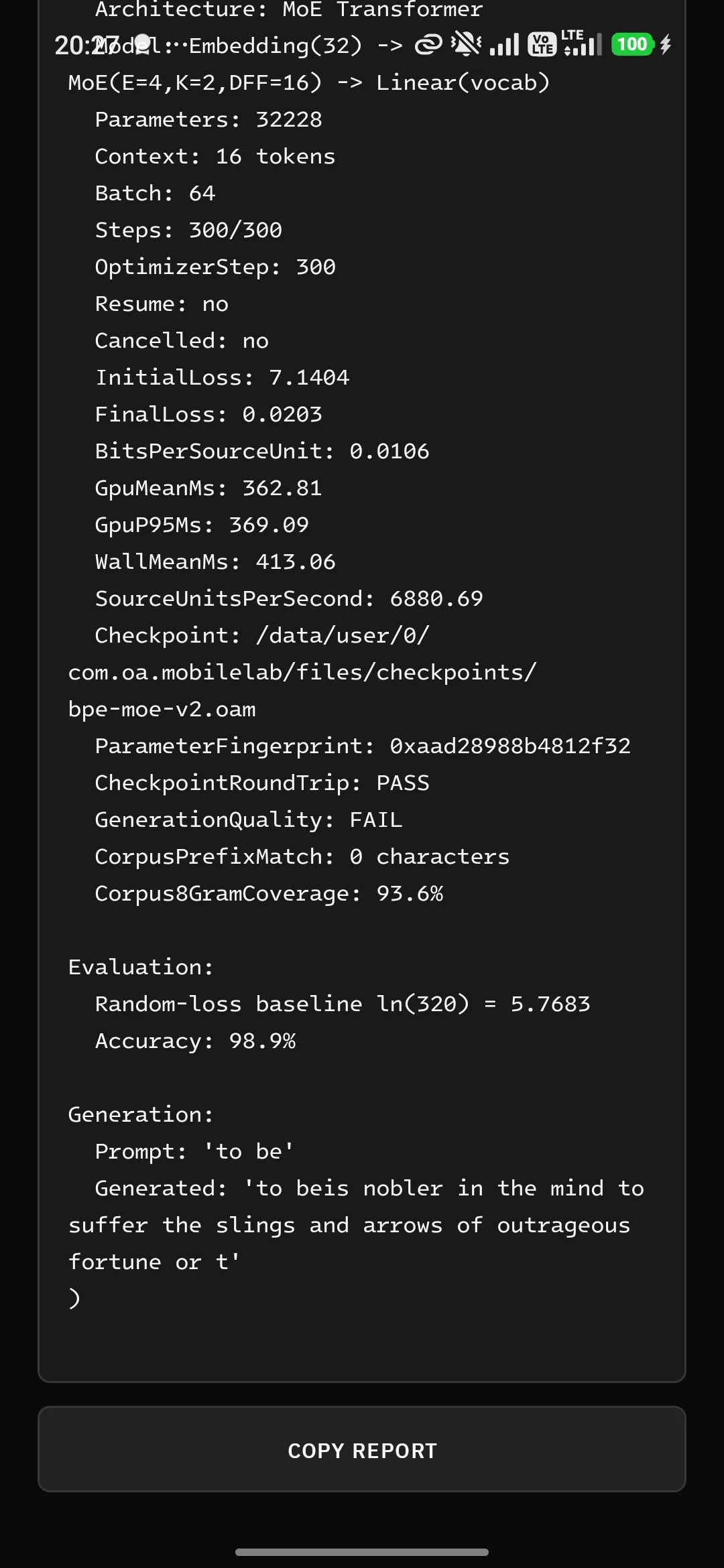
Mobile Lab proves that OA's execution model is portable beyond desktop drivers. The app uses the same model recipes, kernels, autograd, AdamW optimizer, metrics, generation contract, and.oam checkpoints as the desktop suite—without a Java model or CPU substitute.
Real device training
Driver-aware runtime
End-to-end acceptance
Same public architecture
Reference systems
| Desktop reference | Mobile reference | |
|---|---|---|
| GPU | Intel Iris Xe TGL GT2 | Qualcomm Adreno 610 |
| OS | Arch Linux x86-64 | Android 16 / arm64-v8a |
| Driver | Mesa ANV 26.1.4 | Mesa Turnip 26.1.4, app-local |
| Precision | FP32 | FP32 |
Desktop versus mobile
The controlled Byte workload runs 300 AdamW updates with batch 64 and sequence 16. Each row uses the fixed prompt to be, generates 80 bytes, and verifies an exact checkpoint reload. The timing gap describes very different GPUs; matching quality and behavior is the portability result.
| Architecture | Desktop ms/step | Mobile ms/step | Mobile/desktop | Accuracy D/M | Reload + generation |
|---|---|---|---|---|---|
| RNN | 6.30 | 604.31 | 95.92× | 92.3% / 92.3% | Pass |
| GRU | 13.13 | 954.81 | 72.72× | 92.3% / 92.3% | Pass |
| Transformer | 9.42 | 360.83 | 38.30× | 92.5% / 92.5% | Pass |
| MoE Transformer | 15.02 | 397.63 | 26.47× | 92.2% / 93.2% | Pass |
| Mamba-3 | 36.29 | 1,234.19 | 34.01× | 93.0% / 92.7% | Pass |
Sparse MoE is notable at this tutorial shape: mobile wall time is only 1.10× dense Transformer, while its measured GPU mean is slightly lower. This establishes a viable sparse-execution path; it is not presented as a model-quality advantage.